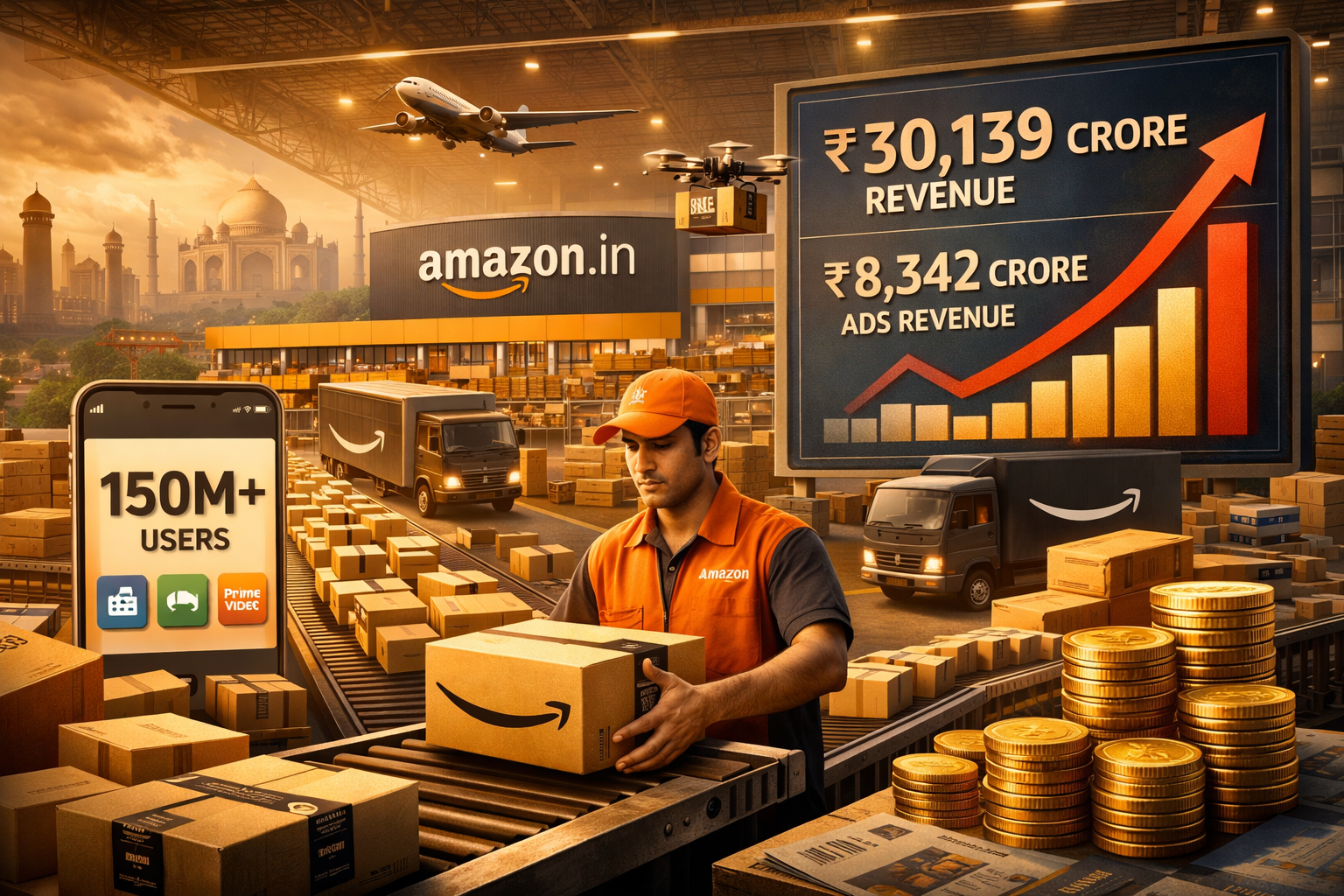
Inside Amazon India’s E-Commerce Success Story

Amazon’s India story is no longer just about scale. It is increasingly about discipline, monetization, and the slow conversion of volume into sustainable economics. After more than a decade of heavy investment, the world’s largest e-commerce company is beginning to show what a mature Amazon India might look like: massive user engagement, industrial-scale logistics, and sharply narrowing losses.

At the heart of this operation is a consumer base that now exceeds 150 million active users, placing Amazon among the most widely used digital platforms in the country. These users are spread across metros, Tier-2, and increasingly Tier-3 towns, reflecting how online commerce has become a default channel rather than an urban luxury. Supporting them is an ecosystem of roughly 218,000 active sellers and a catalogue running into an estimated 168 million products, making Amazon one of the deepest retail marketplaces in India.

Amazon does not disclose daily or monthly transaction numbers in India. However, industry estimates and operational disclosures during major sale events offer a reliable window into the platform’s scale.

On normal trading days, Amazon India is estimated to process around 1.5 to 2 million orders per day. That translates into roughly 45 to 60 million transactions per month outside peak festive periods. During large sale events such as Prime Day or the Great Indian Festival, volumes spike dramatically. At peak moments, Amazon India has publicly reported handling more than 18,000 orders per minute, underlining the capacity of its fulfilment and logistics backbone.

These peaks are not representative of everyday demand, but they demonstrate the system’s ability to absorb extreme surges without breakdown — a critical competitive advantage in a market where reliability often determines customer loyalty.

For years, Amazon India’s financial narrative was defined by losses driven by logistics expansion, customer acquisition, and discounting. That narrative is now changing.

In FY25, Amazon Seller Services, the company’s primary marketplace entity in India, reported revenues of approximately ₹30,139 crore, a year-on-year growth of about 19 percent. More striking than the top-line growth was the bottom line: losses narrowed sharply to around ₹374 crore, compared with multi-thousand-crore losses just a few years earlier.

This improvement reflects tighter cost controls, better seller monetisation, and a gradual reduction in subsidy-led growth. Operating cash flows have turned positive in recent periods, signalling that Amazon India’s core marketplace is approaching financial breakeven.

Advertising has emerged as a key pillar in this transition. In FY25, Amazon India’s advertising business generated an estimated ₹8,342 crore, accounting for nearly one-third of total marketplace revenue. Sponsored listings, brand stores, and performance ads have become central to seller strategy, mirroring trends already seen in the US and Europe.

Amazon Pay, the company’s payments arm in India, continues to grow in usage but remains loss-making. FY25 revenues were in the range of ₹2,100–2,200 crore, with net losses of roughly ₹866 crore. The unit plays a strategic role rather than a purely financial one, reinforcing customer stickiness and supporting marketplace transactions, even as profitability remains elusive.

Logistics, meanwhile, is one of Amazon India’s most formidable strengths. In 2024 alone, the company reported over 41 crore same-day and next-day deliveries. This network, built through years of capital-intensive investment, now acts as a moat that is difficult for competitors to replicate quickly.

GMV Versus Revenue: Understanding the Difference

Amazon India’s reported revenues represent marketplace fees, commissions, advertising income, and services — not the total value of goods sold. Based on estimated order volumes and an average order value of around ₹1,600–1,700, industry analysts suggest that Amazon India’s monthly gross merchandise value could be in the range of ₹7,500–10,000 crore in non-peak periods, with significantly higher numbers during festive months.

This distinction is crucial. While GMV reflects consumer spending on the platform, revenue indicates how effectively Amazon monetizes that activity. The narrowing gap between scale and sustainability suggests that monetization efficiency is improving.

Market Position and the Road Ahead

Amazon India is estimated to hold roughly 30–35 percent of the country’s e-commerce market, placing it neck-and-neck with Flipkart in most major categories. Unlike earlier years, growth is now less about headline user acquisition and more about increasing order frequency, advertising yield, and seller services.

The India business may still be small compared to Amazon’s North American operations, but its strategic importance is disproportionate. India is one of the few markets globally where Amazon can still add tens of millions of new digital consumers over the next decade.

After years of prioritizing reach over returns, Amazon India appears to be entering a new phase, one where scale is no longer the goal, but the foundation. The real test ahead is whether the company can convert its enormous transactional engine into consistent, long-term profitability without losing the price-sensitive Indian consumer.

For now, the numbers suggest that the inflection point is closer than ever.

The Nuclear Double Standard: Why Some Nations Can Have it While Others Cannot

In the theatre of global power, few symbols carry as much weight as the nuclear weapon. Ever since the United States dropped atomic bombs on Hiroshima and Nagasaki in 1945, nuclear arms have remained the ultimate deterrent, a tool for both security and geopolitical leverage. Yet, while a select club of nations continues to possess these devastating weapons, others are harshly sanctioned, isolated, or even invaded at the mere suggestion of pursuing them. This enduring double standard warrants scrutiny.

The United States, along with Russia, China, the United Kingdom, and France — the five officially recognized nuclear powers under the 1968 Nuclear Non-Proliferation Treaty (NPT) — remain the custodians of nuclear arsenals. These nations were grandfathered into legality simply because they developed their arsenals before a cut-off date. The treaty aimed to prevent the spread of nuclear weapons while gradually working toward global disarmament. More than five decades later, disarmament remains a distant ideal, and non-proliferation has morphed into a tool of selective enforcement.

Consider the case of Iran, a country that has faced crippling sanctions and military threats for its nuclear ambitions, despite no confirmed weaponisation. North Korea, having successfully tested nuclear weapons, now exists in a peculiar state of sanctioned deterrence. Meanwhile, nations like Israel, widely believed to possess nuclear arms, enjoy a shield of diplomatic silence from Western powers, particularly the United States.

The justification is often couched in the language of global security. More nuclear-armed states, it is argued, increase the likelihood of conflict, accidental launches, or nuclear terrorism. There is truth to this concern. The more fingers on the proverbial button, the higher the risks. But to suggest that only certain nations are responsible enough to wield such power is a claim rooted in political self-interest, not principle.

For the United States and its allies, preventing proliferation is as much about preserving strategic dominance as it is about safeguarding peace. Nuclear weapons grant nations not only military deterrence but also disproportionate diplomatic influence. The idea of potential adversaries acquiring similar leverage is understandably uncomfortable for those invested in maintaining the current balance of power.

This double standard has consequences. It fosters resentment, fuels regional arms races, and undermines the credibility of international institutions tasked with promoting fairness and stability. As long as nuclear disarmament remains a rhetorical goal and not an actionable policy among the existing nuclear powers, attempts to police others will be viewed with suspicion, if not outright hostility.

The world faces a stark choice. Either move earnestly towards universal disarmament — as originally promised under the NPT — or acknowledge the hypocrisy embedded in the current order. The status quo, where power is held by a few and denied to others, only perpetuates global inequality and deepens distrust.

Until then, the nuclear question will remain less about morality and more about who has the power to decide.

From Conflict to Caution: India-Pakistan Ceasefire 2025

India and Pakistan have agreed to an immediate ceasefire, meditated by USA.

Given the kind of history Pakistan have with India, it would not hold much. As I write this, sirens are blowing in Jammu & Kashmir as Pakistan violated the agreement.

Here are my readings: 🔖

Terrorists came, killed 26 Indians, almost 99% of them Hindus, returned safely to their places. They asked the religion of victims and killed them.

Said: “Bata dena Modi ko. Still they returned safely.”

Immediately after the incident, Modi attended a rally in Bihar while home minister went to Pahalgam.

Modi government got support from all opposition parties and everyone in India. But official handle of BJP kept insulting Congress and past PMs, specially Congress of UPA era.

India attacked and destroyed some terrorist camps. Pakistan attacked in return. More civilians killed. One agniveer who came from a very poor background got killed. Total life lost is close to 50.

Pakistan kept attacking India. India kept attacking Pakistan. The war was getting heavier and heated.

USA and world initially said: “India should do whatever it wishes. It is their right to respond”

Then VP DJ Vance said: “we have no business with India and Pakistan. Let them do whatever they want.”

India opposed $1 billion funds of IMF to Pakistan. But it was approved immediately.

As India was trying to bleed Pakistan. USA forced India to have a ceasefire.

Result:

We have been fucked and played by Western Powers specially USA. India will keep bleeding and USA will again do this nonsense bloody forced diplomacy.

Iron Lady Indira Gandhi showed all her middle fingers to USA. Modi can’t become Nehru or Manmohan Singh or Ataj Bihari Vajpai or Indira Gandhi. Not in this birth. He will remain an inflated PR generated baloon.

Peace is always Good. 99% of us do not want war. Peace has prevailed. But long term peace between India and Pakistan will remain a dream.

: Bihari Chaupal

“70 Hours a Week? The New Age Work-Life Balance Question”

On this labor day, I remember the great visionaries of India, who asked us to work for 70 hrs/week, 90 Hrs/week or even more. I am NOT VERY HAPPY with them, because they could have asked for at least 120 hrs/week.

If you are not working for 20 hrs/day for the monthly salary of Rs 30,000, or if you have a decent pay of $0.60/hr, why you are complaining. TCS and Infosys have this great culture. They pay you like one was paid in 2002, but they ask you to work for 100 hrs/week in 2025.

I don’t understand why you ask for work life balance. The CEOs of such companies hate work life balance. Why you care if they are paid hundreds of crores for their commander like behavior.

👇 Here are the snippets of what they said:

🧠 Narayana Murthy (Co-founder, Infosys): In 2024, Murthy reignited discussions on work ethics by suggesting that young Indians should work 70 hours a week to boost national productivity. He expressed skepticism about the concept of work-life balance, emphasizing hard work as essential for India’s progress.

🏗️ S.N. Subrahmanyan (Chairman, Larsen & Toubro): Subrahmanyan stirred controversy by expressing regret over not being able to make staff work on Sundays, implying a desire for a 90-hour workweek. His remarks faced significant backlash, with critics highlighting the unrealistic and harmful nature of such expectations.

🚕 Bhavish Aggarwal (co-founder and CEO of Ola): He has been a prominent advocate for extended working hours in India, aligning with Infosys founder Narayana Murthy’s call for a 70-hour workweek. In a 2024 interview with ANI, Aggarwal expressed his full support for this idea, stating:​I should do more, and I’m fully in sync with his (Murthy’s) direction to the youth.” He further emphasized his commitment by revealing that he personally works 20 hours a day, seven days a week.

His views on Work-Life Balance : Aggarwal has also challenged conventional notions of work-life balance. “I don’t think work-life balance is the right construct. This Saturday-Sunday off is not an Indian thing; this is a western thing.” He argued that the concept of weekend rest days originated from the Industrial Revolution in the West and doesn’t align with India’s traditional work culture. Aggarwal believes that if individuals enjoy their work, they will find happiness in both life and work, rendering the idea of a strict work-life separation unnecessary.

💼 Harsh Goenka (Chairman, RPG Group): Goenka has been a vocal advocate for work-life balance. He criticized the glorification of long working hours, stating that turning life into a perpetual office shift leads to burnout. He emphasized the importance of flexibility and hybrid work models. ​

🏢 Ashwin Yardi (CEO, Capgemini India):

Yardi advocated for a structured work schedule, promoting a 47.5-hour workweek and discouraging weekend emails. He emphasized the importance of respecting personal time and maintaining a healthy work-life balance. ​

🧘 Rohit Kapoor (CEO, Swiggy):Kapoor challenged the hustle culture by highlighting the unproductiveness of sacrificing health and relationships for late-night work sessions. He encouraged prioritizing family time and criticized the normalization of overworking. ​

💡 Nalin Negi (CEO, BharatPe) :Negi emphasized that the quality of work is more important than the number of hours clocked. He stated that a 90-hour workweek is impractical and highlighted the significance of creating an employee-friendly environment. ​

🧭 Anand Mahindra (Chairman, Mahindra Group) : Mahindra weighed in on the debate by asserting that the focus should not be on the quantity of hours worked but on the quality and passion brought to those hours. He emphasized the importance of meaningful contributions over long work hours.

What is your take on this ?

नफ़रत का सौदागर

मैं धार्मिक नफरत का सौदागर हूँ

मुझे इंसानों में ही,

अपनी खेती दिखती है।

इंसानी खून को,

मैं सीढ़ी बनाकर

इतना ऊपर पहुँच जाता हूँ,

जहाँ उनकी रुदन सुनाई नहीं देती है।

मेरे संबल हैं वो करोड़ो लोग,

जो उतने ही नफरती

और जहरीले हैं।

मैं एक धर्मयुद्ध लड़ रहा हूँ

मेरी नफरत ही मेरा नश्तर है।

— Bihari Chaupal

Why do we celebrate GOOD FRIDAY

Good Friday is observed to commemorate the crucifixion of Jesus Christ and his death at Calvary. It’s a solemn day in the Christian calendar, marking the sacrifice believed to have redeemed humanity’s sins. The term “Good” refers to the day’s sacredness and its spiritual significance — not that the events were joyful.

Historically, it’s rooted in early Christian tradition and has been observed since at least the 4th century. It falls on the Friday before Easter Sunday, as part of the Holy Week.

Though not universally a public holiday in India, states like Kerala, Goa, and Nagaland observe it officially due to significant Christian populations.

From a sociological angle, the ritual of mourning, silence, and prayer on Good Friday symbolizes collective memory, grief, and hope — key elements in any community’s cultural and moral fabric.

Website Powered by WordPress.com.

Up ↑